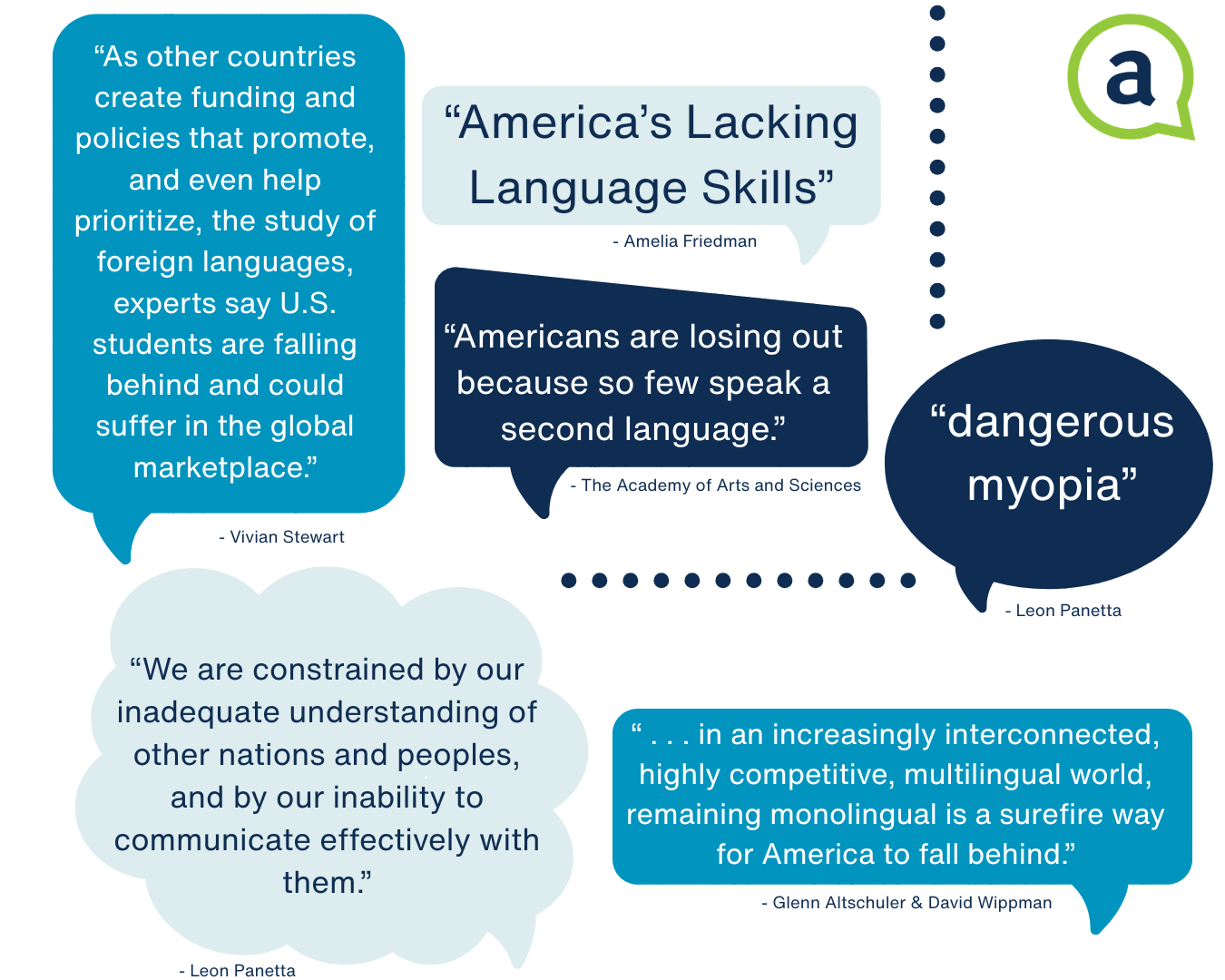
In 2009, Vivian Stewart, then Vice President of Education of the Asia society, wrote, “As other countries create funding and policies that promote, and even help prioritize, the study of foreign languages, experts say U.S. students are falling behind and could suffer in the global marketplace.”
In 2015, Amelia Friedman, author of the Atlantic article, “America’s Lacking Language Skills,” explained that less than 1% of U.S. adults are proficient in a language they studied in school. In contrast, according to statistics from the European Commission and Eurostat, 79% of young people between the ages of 15 and 24 are able to speak at least two languages. And by upper secondary, nearly half of students are studying at least two additional languages.
In 2018, The Academy of Arts and Sciences reposted an article from the San Francisco Chronicle with a similar headline, “Americans are losing out because so few speak a second language.” Author, Leon Panetta writes that despite the United States being a military super power, “we are constrained by our inadequate understanding of other nations and peoples, and by our inability to communicate effectively with them.” He goes on to express that he is disturbed by our “dangerous myopia” in continuing to “to neglect training and education in languages other than English.”
In 2022, scholars, Glenn Altschuler and David Wippman, wrote “ . . . in an increasingly interconnected, highly competitive, multilingual world, remaining monolingual is a surefire way for America to fall behind.” Their concern comes on the heels of the war in Ukraine. Because the U.S. lacks foreign language skills, they explain, the Defense Department is unable to fill most of its 30,000 language positions. This in turn negatively impacts everything from diplomacy to intelligence gathering.
In 2023, the Deputy Secretary of Defense confirmed their concern in a memorandum outlining the importance of improving the growth and management of Language, Regional Expertise, and Culture (LREC) talent. The memorandum explains that due to a lack of candidates with critical foreign language proficiency skills, it is necessary to develop foreign language proficiency on the job.
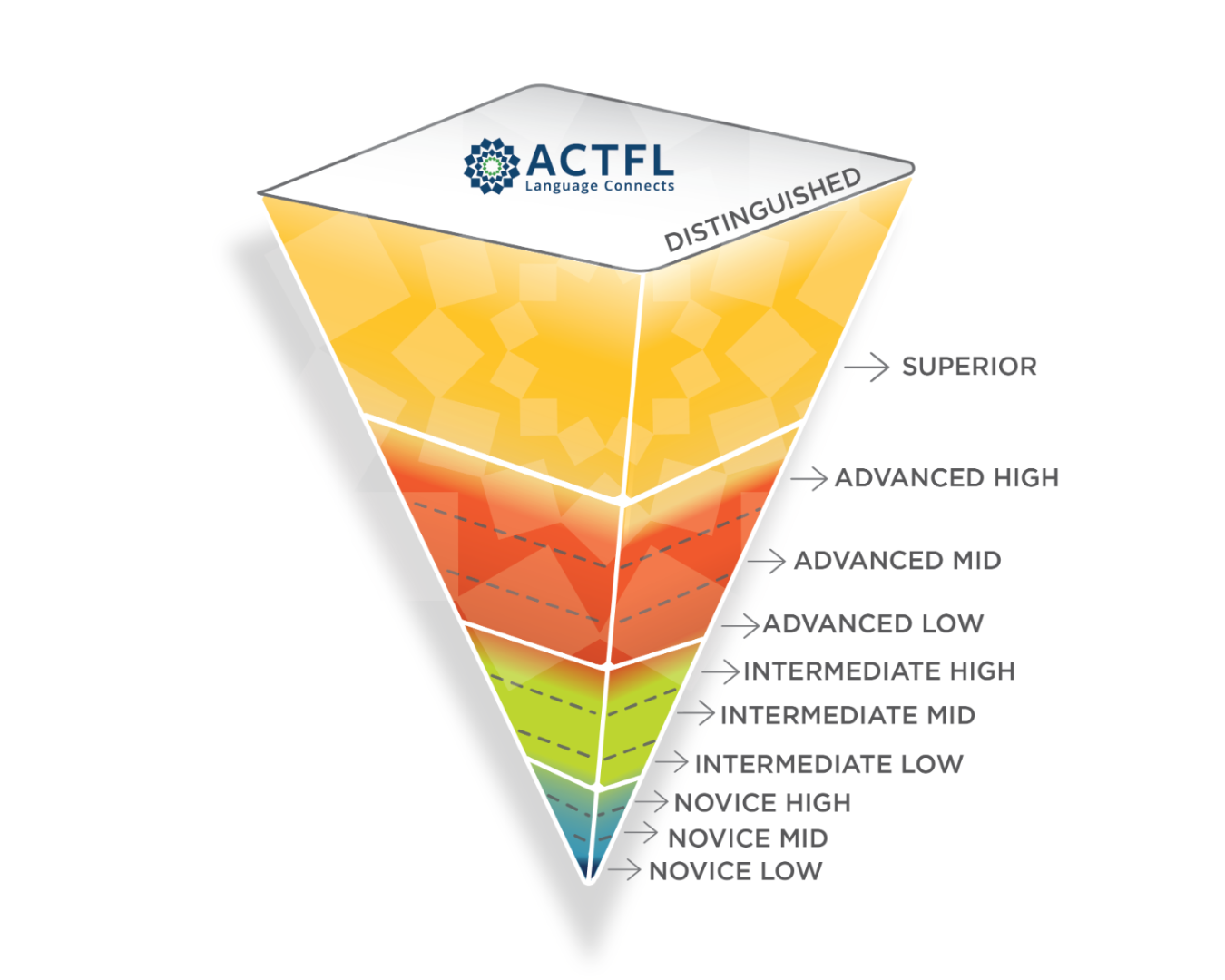
The problem, however, is that for first time language learners, it takes eight years or more to attain high enough levels of proficiency “needed to translate, interpret, and assess complex information.” And because contracts typically extend only five years, most language professionals only acquire “apprentice level qualifications.”
After identifying the problem, the memorandum outlines phase one of a proposed improvement plan. As part of the plan, they will expand and better resource their language training centers and incentivize attainment of master levels of proficiency. While these improvements may help, they will not solve the underlying problem of English monolingualism. As an educator and second language acquisition specialist, I know that expanding and resourcing training centers won’t decrease the number of years it takes for first time adult language learners to acquire master levels of proficiency. I also know that incentivizing the attainment of master levels of proficiency for current service people and civilians won’t increase the existing pool of candidates who already possess those skills. But there is a plan that can decrease time spent on proficiency training and increase the pool of candidates with critical foreign language proficiency skills. It just lies outside the main jurisdiction of the DoD.
If we want a multilingual workforce to fill the vacancies in the DoD’s 30,000 critical language positions, improve diplomatic relations, and increase national security, we need to build one. To build a multilingual workforce, however, we cannot start with adults and on-the-job proficiency training. We need to start with children and K-12 education. Instead of an education system designed to foster and reward English monolingualism, we need one that fosters and rewards bilingualism and biliteracy.

And while shifting a monolithic system like U.S. education from English monolingualism to multilingualism may be daunting, it is possible. Here’s the good news. First, we already have a model to follow in quality dual language immersion programs. Quality dual language immersion programs provide a significant amount of content instruction in a partner language (a language other than English) so students develop bilingual proficiency as they learn academic subjects. Instead of aligning instruction and assessment solely to the goal of academic achievement in English, quality dual language programs align instruction and assessment to the additional goals of bilingualism, biliteracy and cultural competency. Second, we already have proof of concept. Decades of research demonstrate that all students, both those the federal government identifies as English Learners and those who speak English at home, benefit from learning in dual language programs, academically, socially, and even financially. Finally, the shift has already started. According to a 2023 Hechinger Report, the number of dual language immersion programs has quadrupled since 2010.
But, we still have a long way to go if we really want to solve the problem of English monolingualism. Currently just under 3% of schools provide dual language immersion programs. To build a multilingual workforce, that percentage needs to increase exponentially. That’s where YOU come in. By implementing a quality dual language immersion program in your school or district, you become part of the solution to the problem of English monolingualism. And don’t worry if you have no idea how or where to start. We can help you–every step of the way.
Stacey Washburn (Vanden Bosch) is passionate about raising the status of languages other than English in schools.
Stacey and her team design systems and resources teachers can use to prioritize partner language development in their classrooms.