
Language
Guidelines for Cross-linguistic Connections
Stacey Washburn (Vanden Bosch)
Guidelines from the Addalingua Approach
Cross-linguistic connections can be powerful, but they need to be taught with intention. In dual language immersion classrooms, the goal is not simply to compare English and the partner language, but to help students notice how languages work while continuing to prioritize partner language development. These 7 guidelines from the Addalingua approach can help teachers make cross-linguistic instruction explicit, protect partner language instructional time, and avoid turning language comparisons into direct translation.
1. Develop a culture that requires sole use of the partner language during partner language instructional time, even when making cross-linguistic connections.
There are a lot of ways to get started, but one of the most effective is having a policy and structure in place that reflects high expectations for sole use of the partner language during partner language instructional time. It stops English from taking over and increases student output in the partner language. By maintaining high expectations for exclusive partner language use, you can avoid English take-over when students make cross-linguistic connections on their own. So, for example, if you’re teaching students the silent “h” in Spanish and one of your students spontaneously blurts out that the English “h” makes a sound, they’ll be more likely to make the connection in Spanish, without reverting to English.
Write your awesome label here.
If you’re not sure how to get started with a policy and structure of your own, feel free to use ours. You can learn more by subscribing to Educator Basic plus+ for our first PLPT (Partner Language Policy and Timeline) course.
2. Develop student awareness of grammar, syntax and word features in the partner language from day one (as early as preschool and kindergarten).
By drawing students’ attention to features in the partner language that differ from English such as article/noun agreement in romance languages or the use of the particle 了 to indicate an action is completed in Chinese, you are preparing them for formal cross-linguistic instruction later. And make it a seamless part of content instruction. Ditch boring grammar worksheets and language drills! You can make it fun for even the youngest students by teaching them to be “language detectives” on the hunt for clues that deepen their understanding of language as they engage with texts or conduct science experiments. If you are wondering how to get started with things like identifying partner language targets and building student language awareness as you teach content, you can register for our free "Language Poster” course.
3. Understand which language features will transfer to English without explicit instruction and which will not.
Features (letter sounds, word order, punctuation, etc.) that are the same between languages will transfer. That means you can teach the language feature in the partner language and trust that it will transfer to English. During English instruction, instead of reteaching a particular feature, you can simply point out that it is the same in English as the partner language and celebrate what students already know.
Features that differ between languages require explicit instruction and can become your focus for cross-linguistic comparisons (see step 2 in the TEACH sectionKnowing the difference between transferable and non-transferable language features will help you use instructional time in each language as efficiently as possible.
Use the examples in Spanish and English below to help you identify similarities (transferable) and differences (non-transferable) between English and the partner language of instruction in your program.
Transferable language features (same in both languages):
Non-transferable language features (unique to each language):Spanish:
Features that differ between languages require explicit instruction and can become your focus for cross-linguistic comparisons (see step 2 in the TEACH sectionKnowing the difference between transferable and non-transferable language features will help you use instructional time in each language as efficiently as possible.
Use the examples in Spanish and English below to help you identify similarities (transferable) and differences (non-transferable) between English and the partner language of instruction in your program.
Transferable language features (same in both languages):
- Nouns name people, places, things, and ideas.
- Nouns can be singular or plural.
- Articles precede and identify nouns.
Non-transferable language features (unique to each language):Spanish:
- Nouns are masculine or feminine.
- Spanish: Articles agree with the nouns they identify in gender and number.
- English: Nouns do not have gender.
- Articles do not agree in number with nouns they identify.
4. Teach transferable and non-transferable partner language features during partner language instructional time.
Teaching as many partner language features (whether they are the same as or different from English) establishes the partner language as the “primary” academic language. By building metalinguistic awareness in the partner language first, you send the message that it is worth analyzing and understanding. It also allows you to limit English instruction to teaching what is different from the partner language.
So, continuing with the example of nouns and articles, during Spanish instructional time, teach a series of lessons in which students learn:
Articles agree in gender and number with the nouns they identify (different/non-transferable)
So, continuing with the example of nouns and articles, during Spanish instructional time, teach a series of lessons in which students learn:
- Nouns name people, places, things and ideas (same as English/transferable)
- Nouns have gender (different/non-transferable)
- Nouns can be singular or plural (same/transferable)
- Articles identify and precede nouns (same/transferable)
Articles agree in gender and number with the nouns they identify (different/non-transferable)
5. Teach non-transferable English language features through cross-linguistic instruction during English instructional time.*
*We recommend waiting until after students have acquired foundational language skills in the partner language whenever possible and are more developmentally ready to make cross-linguistic connections (second or third grade).
Using English instructional time for explicit cross-linguistic instruction not only helps you avoid the potential for “English take-over” during partner language instructional time, it also sends an important message to students: Learning in English relies on what you already know in Spanish (or other partner language). It also invites the partner language into English instructional time which helps prioritize its development.
Using English instructional time for explicit cross-linguistic instruction not only helps you avoid the potential for “English take-over” during partner language instructional time, it also sends an important message to students: Learning in English relies on what you already know in Spanish (or other partner language). It also invites the partner language into English instructional time which helps prioritize its development.
6. Develop cross-linguistic objectives that are connected to content instruction and highlight what is different between Spanish and English.
So, for example to continue with nouns and articles, you might decide to identify the following cross-linguistic language objective in conjunction with teaching a shared read aloud in English.
Cross-linguistic objective: I can identify articles and nouns in a shared read aloud and explain how they are the same and different from Spanish.
Cross-linguistic objective: I can identify articles and nouns in a shared read aloud and explain how they are the same and different from Spanish.
7. Teach the objective without using direct translation.
Here’s a model to help you get started.
Prior to reading, ask students to recall what they learned about articles and nouns during Spanish instructional time. Together compile a list of examples that demonstrate number and gender agreement between nouns and articles.
Prior to reading, ask students to recall what they learned about articles and nouns during Spanish instructional time. Together compile a list of examples that demonstrate number and gender agreement between nouns and articles.
| los gatos | los gato |
| las gatas | la gata |
| el perro | los perros |
| la perra | las perras |
During the shared read aloud, ask students to write down examples of nouns and articles they identify in the text as they take turns reading.Pause to ask questions related to the reading lesson objective as students record their examples. At the end of the shared read, ask students to share their examples of nouns and articles.
Write them next to the examples of Spanish. If the example students identify is singular, include the plural form as well.
Write them next to the examples of Spanish. If the example students identify is singular, include the plural form as well.
| Student Examples | Teacher Modification |
| the chickens | the chicken |
| the goats | the goat |
| the mare | the mares |
| the stallion | the stallions |
Ask students to identify similarities and differences between articles/nouns in Spanish and English.
Conclude the lesson by visually displaying a t-chart with “same” on one side and “different” on the other.
Conclude the lesson by visually displaying a t-chart with “same” on one side and “different” on the other.
Same
- Nouns name people, places, things and ideas
- Nouns can be singular or plural
- Articles identify nouns
- Articles precede nouns
Different
- In English nouns are not masculine or feminine. In Spanish they are.
- In English articles don’t change to agree with the nouns they identify. In Spanish they do.
By following these guidelines, you will not only avoid English take-over and direct translation, you will also promote cross-linguistic awareness that prioritizes partner language development. To learn more about prioritizing the partner language to boost bilingualism and biliteracy and ultimately academic achievement, please . . . .
Meet the Author:
Stacey Washburn (Vanden Bosch) is passionate about raising the status of languages other than English in schools.
She is the co-author of Six Practices that Boost Bilingualism and Biliteracy, the Addalingua Approach to Dual Language Immersion Education, co-creator of the Addalingua approach to dual language immersion education, and co-founder of Addalingua, an EdTech company dedicated to promoting global empathy by prioritizing partner languages in dual language education.
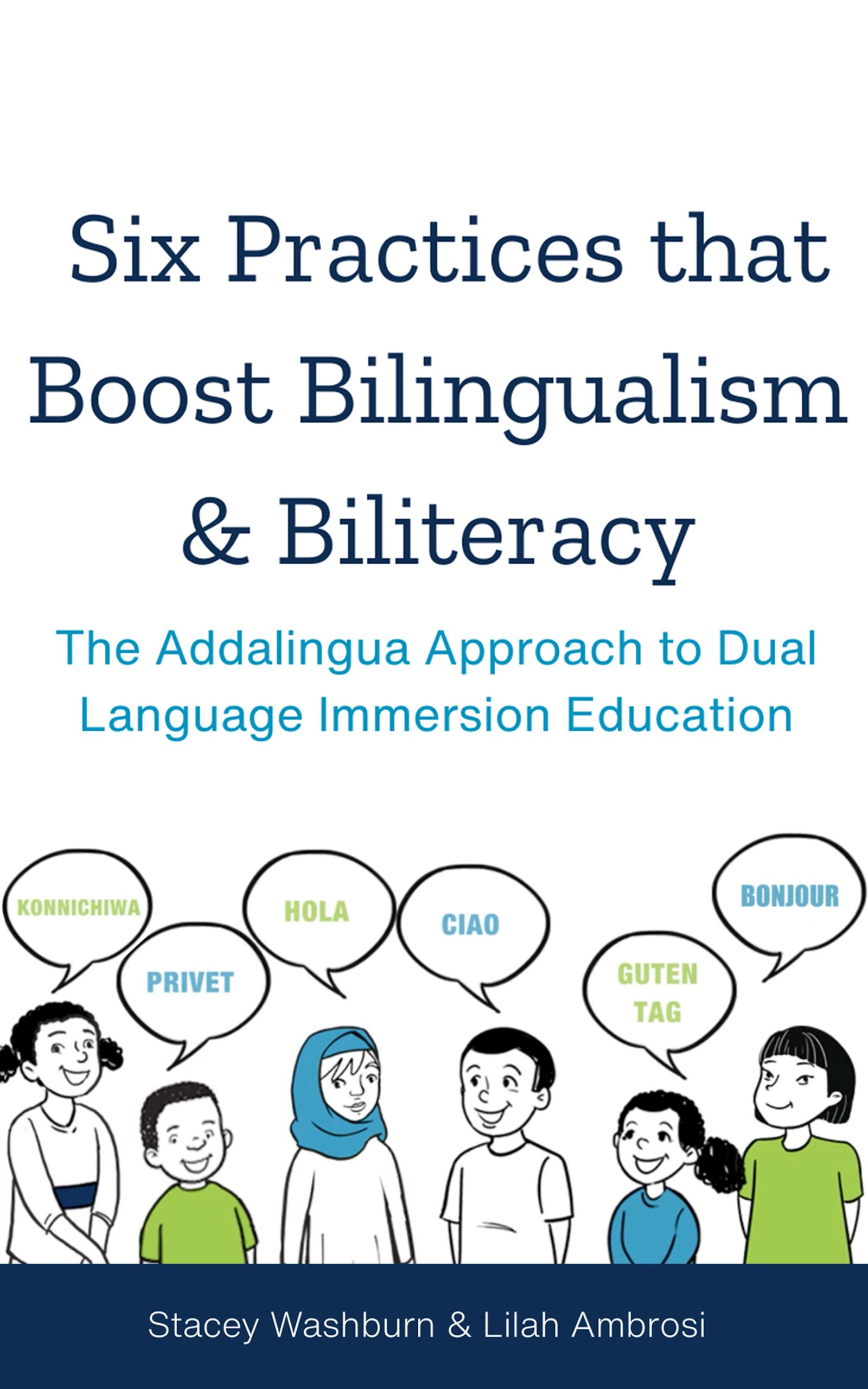
Stacey and her team design systems and resources teachers can use to prioritize partner language development in their classrooms.
References:
Montelongo, J.A., & A.C. Hernández. “The Teachers’ Choices Cognate Database for K-3 Teachers of Latino English Learners,” Reading Teacher (November 2013).
https://www.daytranslations.com/blog/the-language-classroom-the-lingua-franca-dilemma-english-dominance-and-its-implications/
García AM, Ibáñez A, Huepe D, Houck AL, Michon M, Lezama CG, Chadha S, Rivera-Rei A. Word reading and translation in bilinguals: the impact of formal and informal translation expertise. Front Psychol. 2014 Nov 12;5:1302. doi: 10.3389/fpsyg.2014.01302. PMID: 25429279; PMCID: PMC4228976.
Tedick, D. J., & Lyster, R. (2020). Scaffolding language development in Immersion and Dual Language Classrooms. Routledge.
Hamman, Laura. (2018) Translanguaging and positioning in two-way dual language classrooms: a case for criticality, Language and Education, 32:1, 21-42, DOI: 10.1080/09500782.2017.1384006
Blog post from Dr. Ana Mendoza – https://annamend.com/blog/
Morita-Mullaney, T., Renn, J., & Chiu, M. M. (2022). Spanish language proficiency in dual language and English as a second language models: the impact of model, time, teacher, and student on Spanish language development. International Journal of Bilingual Education and Bilingualism, 25(10), 3888–3906.
https://doi.org/10.1080/13670050.2022.2089012https://www.teachingforbiliteracy.com/wp-content/uploads/2014/09/The-Bridge-Making-Cross-Linguistic-Connections-p.-1-6.pdf
Jiménez, R.T., & A. Gámez. “Literature-Based Cognitive Strategy Instruction for Middle School Latina/o Students,” Journal of Adolescent and Adult Literacy (1996).
Koop & Vanden Bosch - presentation
Torregrossa, J., & Carbonara, V. (2025). Exploring the benefits of translanguaging pedagogies on secondary-school students’ metalinguistic awareness: the role of language learning aptitude and vocabulary knowledge. Language Awareness, 34(4), 862–885. https://doi.org/10.1080/09658416.2025.2608085
Beeman, K., & Urow, C. (2013). Teaching for biliteracy: Strengthening bridges between languages. Caslon Publishing.
https://www.daytranslations.com/blog/the-language-classroom-the-lingua-franca-dilemma-english-dominance-and-its-implications/
García AM, Ibáñez A, Huepe D, Houck AL, Michon M, Lezama CG, Chadha S, Rivera-Rei A. Word reading and translation in bilinguals: the impact of formal and informal translation expertise. Front Psychol. 2014 Nov 12;5:1302. doi: 10.3389/fpsyg.2014.01302. PMID: 25429279; PMCID: PMC4228976.
Tedick, D. J., & Lyster, R. (2020). Scaffolding language development in Immersion and Dual Language Classrooms. Routledge.
Hamman, Laura. (2018) Translanguaging and positioning in two-way dual language classrooms: a case for criticality, Language and Education, 32:1, 21-42, DOI: 10.1080/09500782.2017.1384006
Blog post from Dr. Ana Mendoza – https://annamend.com/blog/
Morita-Mullaney, T., Renn, J., & Chiu, M. M. (2022). Spanish language proficiency in dual language and English as a second language models: the impact of model, time, teacher, and student on Spanish language development. International Journal of Bilingual Education and Bilingualism, 25(10), 3888–3906.
https://doi.org/10.1080/13670050.2022.2089012https://www.teachingforbiliteracy.com/wp-content/uploads/2014/09/The-Bridge-Making-Cross-Linguistic-Connections-p.-1-6.pdf
Jiménez, R.T., & A. Gámez. “Literature-Based Cognitive Strategy Instruction for Middle School Latina/o Students,” Journal of Adolescent and Adult Literacy (1996).
Koop & Vanden Bosch - presentation
Torregrossa, J., & Carbonara, V. (2025). Exploring the benefits of translanguaging pedagogies on secondary-school students’ metalinguistic awareness: the role of language learning aptitude and vocabulary knowledge. Language Awareness, 34(4), 862–885. https://doi.org/10.1080/09658416.2025.2608085
Beeman, K., & Urow, C. (2013). Teaching for biliteracy: Strengthening bridges between languages. Caslon Publishing.