
Language
Why Cross-Linguistic Connections Matter in DLI
Stacey Washburn (Vanden Bosch)
Prioritizing the Partner Language With Cross-linguistic Connections & Instruction
Whether you are a dual language immersion educator new to cross-linguistic instruction and seeking direction or a cross-linguistic instruction pro looking for additional insight, this blog post is for you! In it I’ll revisit what cross-linguistic connections are, how they benefit students and why it’s important to make them explicit in your instruction. Then, I’ll share some challenges to cross-linguistic instruction that can undermine partner language development and how you can avoid them.
Cross-linguistic Connections & How They Benefit Students
Cross-linguistic connections involve students comparing and contrasting the languages of instruction. When students identify similarities and differences between the partner language and English, it promotes metalinguistic awareness. Metalinguistic awareness, or the ability to analyze and dissect language, supports biliteracy development (Tedick & Lyster, 2020).
Why Cross-linguistic Connections Require Explicit Instruction
Though students will sometimes make cross-linguistic connections on their own, they often need support in the form of explicit instruction, particularly in the early grades. I realized this firsthand during my tenure as developer and director of Spanish and Mandarin Chinese dual language immersion programs within an existing school. In the model I developed for both programs, students received all instruction and assessment in Spanish (or Chinese) until third grade when English was formally introduced for the first time mid-way through the year. Because of this, our dual language immersion students’ first experience with an assessment in English came prior to them receiving any formal English instruction due to state-required achievement testing in the fall of third grade. Needless to say, I was curious about how they would perform compared to their traditionally-educated peers.
I will never forget the relief I felt when reviewing our pioneer Spanish dual language immersion students’ math data. They were performing as well as their mainstream counterparts, despite having only received math instruction in Spanish . . .that is, until I reached the data on geometrical concepts. In this section alone, our students had performed significantly below their mainstream peers. Alarmed, I wondered if perhaps the math curriculum was lacking in some way or if the second grade teacher needed additional support to effectively teach symmetry, perimeter, vertices or angles.
Neither ended up being the case. Meeting with the second grade teacher and reviewing the students’ geometry-related unit tests in Spanish revealed that our students had performed extremely well on the same concepts on their unit tests in Spanish. The discrepancy in their performance between English and Spanish revealed the issue was the language of assessment rather than lack of knowledge. Namely, the section covering geometry contained extensive vocabulary. And though many of the words were cognates, our young dual language students had failed to recognize ‘triangle’ as triángulo or ‘rectangle’ as rectángulo when reading the questions on the English assessment.
This realization along with confirmation from research (Jiménez & Gámez, 1996), prompted me and my then colleague, now co-author, Lilah Ambrosi, to explore how to explicitly teach for cross-linguistic awareness while still focusing on literacy and academic development in Spanish prior to introducing English.
I will never forget the relief I felt when reviewing our pioneer Spanish dual language immersion students’ math data. They were performing as well as their mainstream counterparts, despite having only received math instruction in Spanish . . .that is, until I reached the data on geometrical concepts. In this section alone, our students had performed significantly below their mainstream peers. Alarmed, I wondered if perhaps the math curriculum was lacking in some way or if the second grade teacher needed additional support to effectively teach symmetry, perimeter, vertices or angles.
Neither ended up being the case. Meeting with the second grade teacher and reviewing the students’ geometry-related unit tests in Spanish revealed that our students had performed extremely well on the same concepts on their unit tests in Spanish. The discrepancy in their performance between English and Spanish revealed the issue was the language of assessment rather than lack of knowledge. Namely, the section covering geometry contained extensive vocabulary. And though many of the words were cognates, our young dual language students had failed to recognize ‘triangle’ as triángulo or ‘rectangle’ as rectángulo when reading the questions on the English assessment.
This realization along with confirmation from research (Jiménez & Gámez, 1996), prompted me and my then colleague, now co-author, Lilah Ambrosi, to explore how to explicitly teach for cross-linguistic awareness while still focusing on literacy and academic development in Spanish prior to introducing English.
Challenges to Partner Language Development in Cross-linguistic Instruction.
As we experimented with how and when to implement cross-linguistic instruction, we faced challenges that threatened to undermine rather than prioritize partner language development.
The first challenge came in the form of “English take-over” while experimenting with translanguaging pedagogies. Translanguaging pedagogies “integrate students’ entire linguistic repertoire" throughout instruction (Teorregossa & Carbonara, 2025). In practice, translanguaging invites students to use their “home language” to support learning and promote cross-linguistic awareness (Howard & Simpson, 2023).
When we attempted to engage students in making cross-linguistic connections while using both languages of instruction, however, English took over as the culturally dominant language. Soon we were inadvertently contributing to what translanguaging researcher Laura Hamman (2018) describes as “further inequities by allowing English – and English speakers – to dominate the classroom” (p. 19).
The first challenge came in the form of “English take-over” while experimenting with translanguaging pedagogies. Translanguaging pedagogies “integrate students’ entire linguistic repertoire" throughout instruction (Teorregossa & Carbonara, 2025). In practice, translanguaging invites students to use their “home language” to support learning and promote cross-linguistic awareness (Howard & Simpson, 2023).
When we attempted to engage students in making cross-linguistic connections while using both languages of instruction, however, English took over as the culturally dominant language. Soon we were inadvertently contributing to what translanguaging researcher Laura Hamman (2018) describes as “further inequities by allowing English – and English speakers – to dominate the classroom” (p. 19).
The second challenge came in the form of “direct translation” while experimenting with the “Bridge.” According to Beeman and Urow (2013), the Bridge is a pre-planned lesson at the end of a unit designed to help students compare and contrast Spanish and English. During the Bridge teachers provide English labels for content they learned in Spanish as seen in the anchor chart below.
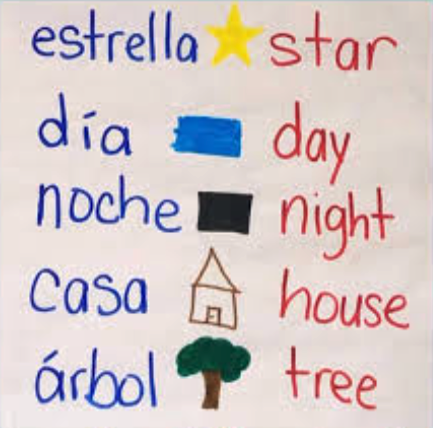
But, such charts seemed to simply invite English into partner language instructional time when it wasn’t necessary. And while the ability to translate is a useful skill, it is not something we wanted our young students to develop while learning to read in Spanish. Translating requires a different cognitive process than reading and can place an unnecessary cognitive load on the brain of a burgeoning reader. When students pause to translate a word before connecting it directly with the object, action or idea itself, it slows down reading comprehension (Gracia et al., 2014). In simple terms, it’s an extra step and one that would distract from partner language development.
While frustrating at the time, overcoming these challenges ultimately helped us develop specific guidelines for cross-linguistic instruction to overcome the potential for English take-over and direct translation. In our blog post on Guidelines for Cross-linguistic Connection, I’ll share some of them with you!
While frustrating at the time, overcoming these challenges ultimately helped us develop specific guidelines for cross-linguistic instruction to overcome the potential for English take-over and direct translation. In our blog post on Guidelines for Cross-linguistic Connection, I’ll share some of them with you!
Meet the Author:
Stacey Washburn (Vanden Bosch) is passionate about raising the status of languages other than English in schools.
She is the co-author of Six Practices that Boost Bilingualism and Biliteracy, the Addalingua Approach to Dual Language Immersion Education, co-creator of the Addalingua approach to dual language immersion education, and co-founder of Addalingua, an EdTech company dedicated to promoting global empathy by prioritizing partner languages in dual language education.
Stacey and her team design systems and resources teachers can use to prioritize partner language development in their classrooms.
References:
Montelongo, J.A., & A.C. Hernández. “The Teachers’ Choices Cognate Database for K-3 Teachers of Latino English Learners,” Reading Teacher (November 2013).
https://www.daytranslations.com/blog/the-language-classroom-the-lingua-franca-dilemma-english-dominance-and-its-implications/
García AM, Ibáñez A, Huepe D, Houck AL, Michon M, Lezama CG, Chadha S, Rivera-Rei A. Word reading and translation in bilinguals: the impact of formal and informal translation expertise. Front Psychol. 2014 Nov 12;5:1302. doi: 10.3389/fpsyg.2014.01302. PMID: 25429279; PMCID: PMC4228976.
Tedick, D. J., & Lyster, R. (2020). Scaffolding language development in Immersion and Dual Language Classrooms. Routledge.
Hamman, Laura. (2018) Translanguaging and positioning in two-way dual language classrooms: a case for criticality, Language and Education, 32:1, 21-42, DOI: 10.1080/09500782.2017.1384006
Blog post from Dr. Ana Mendoza – https://annamend.com/blog/
Morita-Mullaney, T., Renn, J., & Chiu, M. M. (2022). Spanish language proficiency in dual language and English as a second language models: the impact of model, time, teacher, and student on Spanish language development. International Journal of Bilingual Education and Bilingualism, 25(10), 3888–3906.
https://doi.org/10.1080/13670050.2022.2089012https://www.teachingforbiliteracy.com/wp-content/uploads/2014/09/The-Bridge-Making-Cross-Linguistic-Connections-p.-1-6.pdf
Jiménez, R.T., & A. Gámez. “Literature-Based Cognitive Strategy Instruction for Middle School Latina/o Students,” Journal of Adolescent and Adult Literacy (1996).
Koop & Vanden Bosch - presentation
Torregrossa, J., & Carbonara, V. (2025). Exploring the benefits of translanguaging pedagogies on secondary-school students’ metalinguistic awareness: the role of language learning aptitude and vocabulary knowledge. Language Awareness, 34(4), 862–885. https://doi.org/10.1080/09658416.2025.2608085
Beeman, K., & Urow, C. (2013). Teaching for biliteracy: Strengthening bridges between languages. Caslon Publishing.
https://www.daytranslations.com/blog/the-language-classroom-the-lingua-franca-dilemma-english-dominance-and-its-implications/
García AM, Ibáñez A, Huepe D, Houck AL, Michon M, Lezama CG, Chadha S, Rivera-Rei A. Word reading and translation in bilinguals: the impact of formal and informal translation expertise. Front Psychol. 2014 Nov 12;5:1302. doi: 10.3389/fpsyg.2014.01302. PMID: 25429279; PMCID: PMC4228976.
Tedick, D. J., & Lyster, R. (2020). Scaffolding language development in Immersion and Dual Language Classrooms. Routledge.
Hamman, Laura. (2018) Translanguaging and positioning in two-way dual language classrooms: a case for criticality, Language and Education, 32:1, 21-42, DOI: 10.1080/09500782.2017.1384006
Blog post from Dr. Ana Mendoza – https://annamend.com/blog/
Morita-Mullaney, T., Renn, J., & Chiu, M. M. (2022). Spanish language proficiency in dual language and English as a second language models: the impact of model, time, teacher, and student on Spanish language development. International Journal of Bilingual Education and Bilingualism, 25(10), 3888–3906.
https://doi.org/10.1080/13670050.2022.2089012https://www.teachingforbiliteracy.com/wp-content/uploads/2014/09/The-Bridge-Making-Cross-Linguistic-Connections-p.-1-6.pdf
Jiménez, R.T., & A. Gámez. “Literature-Based Cognitive Strategy Instruction for Middle School Latina/o Students,” Journal of Adolescent and Adult Literacy (1996).
Koop & Vanden Bosch - presentation
Torregrossa, J., & Carbonara, V. (2025). Exploring the benefits of translanguaging pedagogies on secondary-school students’ metalinguistic awareness: the role of language learning aptitude and vocabulary knowledge. Language Awareness, 34(4), 862–885. https://doi.org/10.1080/09658416.2025.2608085
Beeman, K., & Urow, C. (2013). Teaching for biliteracy: Strengthening bridges between languages. Caslon Publishing.