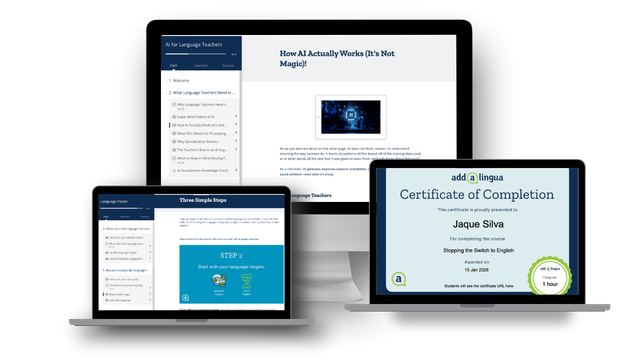
The other day as I was perusing some of the new digital mini-courses we’ll be releasing in July and playing with “Addi,” our new AI teaching assistant trained specifically to support dual language instruction, I was struck by a feeling of excitement that felt deeply familiar. It was the same feeling I had when Lilah and I were first approached by an “angel” investor in 2009.
He had heard about our collaboration as DLI program leaders and the success we were experiencing (program growth, student engagement, community support, high levels of student proficiency in Spanish (and later Chinese) and academic achievement in English) and wanted to chat.
In our first meeting, he asked us to share why we were successful. Here’s the jist of what we said.
We never gave up, despite the “odds” favoring potential failure. We became program leaders in the early 2000s when less than 300 hundred programs existed across the United States. The only two organizations that could offer support were the Center for Advanced Linguistics (CAL) and the Center for Advanced Research on Language Acquisition (CARLA). Budget constraints limited our access to their resources and training. Curricular options in Spanish (later Chinese) were limited. Our school communities were either skeptical about the idea of dual language education or they had never heard of it.
But we were determined. We read nearly every book and research study on education in two languages. We reflected on our personal experiences as former world language and bilingual educators. And then we dove in head first, making programmatic and instructional decisions based on what we learned and our own experience.
It was like trying to “fly a plane while also building it.” Besides doing all the things school leaders do, we were also determining the best way to address . . .
- parent concerns over English language development
- lower than expected proficiency levels in the partner language
- struggling learners
- maintaining support from the school community with program growth
- allocation of instructional minutes
- biliteracy development
- frameworks for instruction that balanced language content across grade levels
- systematic training in DLI pedagogy for the teachers we hired
- progress monitoring in each language of instruction.
And each time we addressed something, we worried about whether or not it would lead to the outcomes we had promised students and their families:
- high levels of bilingualism and biliteracy
- academic achievement at no cost to English development
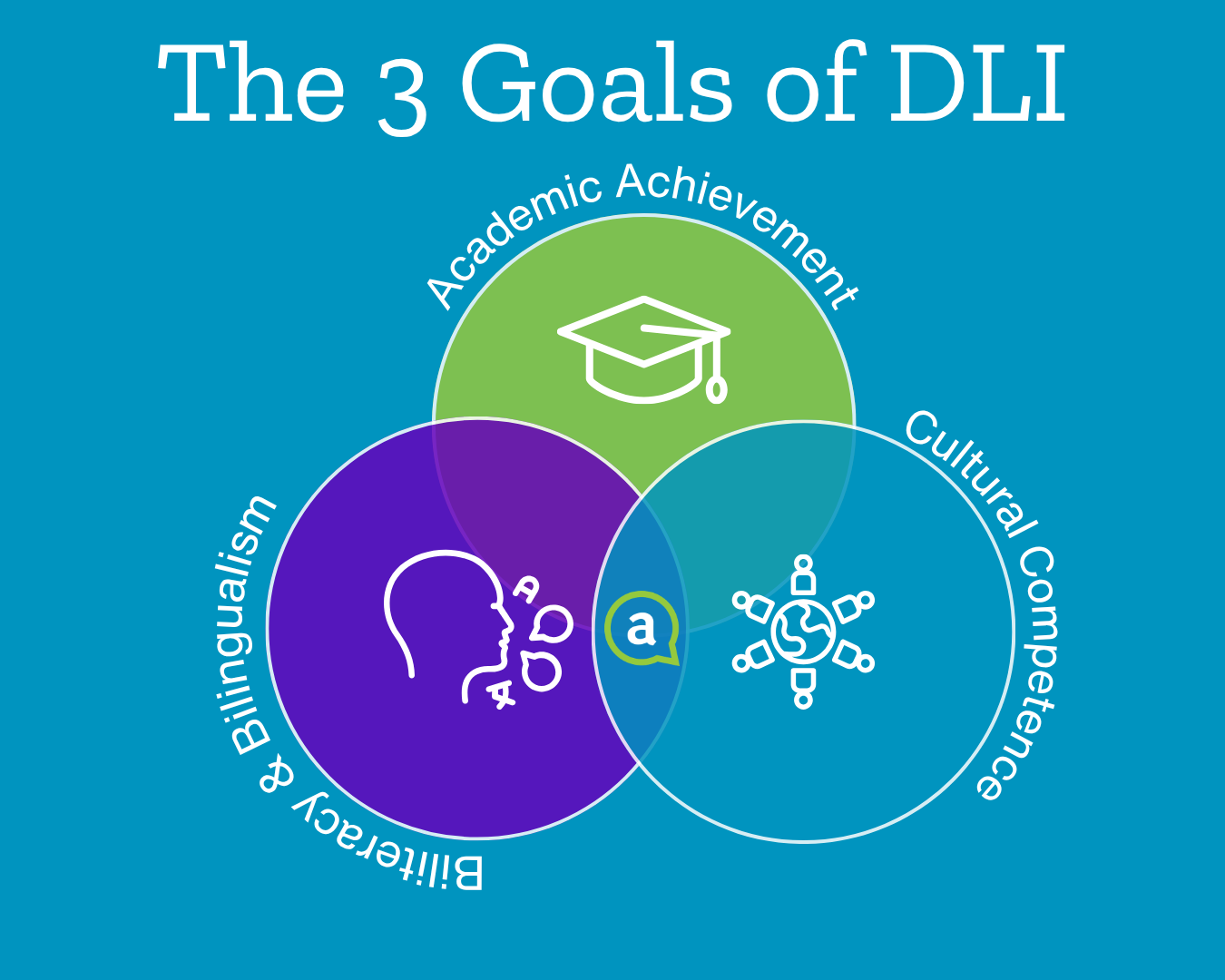
- cultural competence (the ability to connect with others across languages and cultures).
But, as you know, we weren’t giving up, so we lived with the worry. And then we recognized a pattern that changed everything. When we made decisions out of fear that English achievement might suffer, we undermined two of the three outcomes: high levels of bilingualism and biliteracy and cultural competency.
When we made decisions aligned to DLI and SLA research, we supported all THREE outcomes. Once we recognized the pattern we made decisions aligned to research rather than fear. And our students succeeded. Call us gritty, determined, maybe crazy, we said.
Then he asked why we didn’t give up and were so determined. And our answer was this.
Attaining high levels of bilingualism/biliteracy increases the likelihood that students will empathize and connect with others across linguistic and cultural differences. And, to promote understanding and connection across differences well, that’s our passion.
And if we can demonstrate that it’s possible at no cost to academic success in English, we need to do it. We dream of a future when DLI education is available for all students in the U.S.
When it was his turn (finally) to talk, he suggested forming a company. Through this company, he said, you can turn what you’ve learned into resources and training for other current DLI educators or for educators who want to implement programs but don’t know where to start. You can develop everything you wish had been available for you and your teachers when you started.
The thought of bringing to life all we had learned the hard way so others didn’t have to–well, that was exciting. It was exciting to think about taking the guesswork and worry away from educators. It was exciting to think about how making things a little easier might not only protect educators from burnout, but also expand dual language immersion programs and reach more students.
No wonder, the excitement I felt the other day feels so familiar. We’re doing it again. What I see on our new platform astounds me. Not because we built it, but because it has so much potential to make things even easier for DLI educators.
And though since our first tenure as DLI school leaders the number of programs has expanded from under 300 to over 5,000, we have a ways to go before the future we envisioned then becomes the present . . .
When education in two languages is the norm rather than the exception.
Ah, you mentioned that finding texts related to what you were teaching that also included examples of the weekly language target in the Spanish language framework was so much work. So, we developed Addi, your very own DLI specific teaching assistant. Just tell it what you plan to teach about, such as animal habitats for example. Then ask it to write a paragraph, short story, or poem related to animals and their habitats that also uses five examples of your language target. Copy it onto a google doc, print, make copies, and hand them out. Model for your students how to find and highlight the language target. Voila! Great noticing/practice activity to help you counterbalance language and content.
For those of you who don’t yet know us. We’d love to hear from you too! Sign up and
subscribe for free to join our community. There you can post questions, share challenges, and interact with us and other DLI educators.